Convert or Perish
(Note: I used Chat GPT to dictate this article as I hate typing. This may be evident in the formatting but every word and thought is 100% moi.)
I recently presented a webinar via Volunteering Victoria to 20 volunteer managers who live and die on their ability to recruit and retain volunteers.
I thought the conversion formula was of value to them, as it’s an efficient way to gain very specific insights into your audiences, which is important as the more specific your insights are, the more accurately you can target them.

So let’s go through it.
Conversion
By "conversion", I simply mean the capacity to make somebody do what you want them to do— vote for you, donate to you, sign your petition, attend your event or make a phone call to inquire about volunteering. If they do what you wanted, congrats, you've converted them.
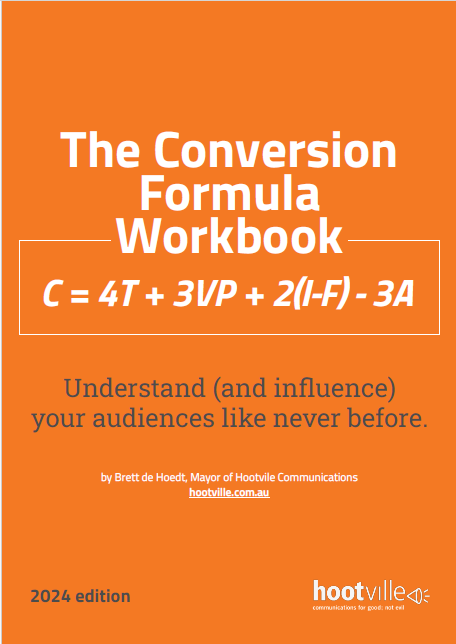
Conversion objectives are many and varied but what this formula recognises is that the final decision for someone to do—or not do—what you want, is the product of many differing factors.
This little formula is considered by all of us, all the time whether we know it or not.
That’s what the conversion formula investigates.

Timing
As per comedy, timing is one of the most important elements of marketing.
The same marketing initiative can gain a very different degree of success based on timing. Depending on what you’re promoting, you might want to reach people at different times of their personal lives - graduation into the workforce, retirement, end-of-life care, pregnancy, marriage or divorce.
All of these life events create a natural uptick in interest in certain things and a reduction in others. Or perhaps it's all about time of year (Christmas, exam time, tax time, school application deadlines, the season, Mother's Day et al).
Or perhaps it's all about the stage of the business cycle - changes to the tax legislation, the uptake of AI, petrol shortages, tarrifs et al.
World events - pandemics, wars, exposure of huge scandals may create opportunity - or conversely render your product or suggestion obselete.
Your capacity to identify these moments—whether in someone’s life stage, the calendar, or their business cycle—is critical.
Can you identify those times and those people and can you get to those people en masse?
Value proposition
People are constantly evaluating the value of everything put in front of us. You evaluated whether it's worth reading this post. (Answer: yes!)
As marketers, we have to make very clear why what we’re proposing is valuable. Can we make it distinct? Better than the competition? More appealing than doing nothing?
What you might find valuable about what you offer may not be what your audience finds valuable. That is a constant challenge.
Eg: Many vocational courses (nursing, aged care) require that sudents complete a job placement before they can graduate. These placements can be very hard to secure. Some education providers guarantee their students a placement and organise it. This is very valuable but 18 year olds who are years away from needing that placement may feel otherwise.
Never underestimate the power of free parking (see Bunnings) or consistency of product (see McDonalds et al) or making something hard, easy (see Xero et al). The chance to feel good about yourself is very valuable indeed (see Shave for a Cure or charity walks) or make a contribution (see ADF or Surf Lifesaving).

Incentive
Incentive refers to anything you can do, say or offer to inspire people to take action faster.
In many cases (certain types of overseas travel, fostering a child, starting a course, making a bequest) people can be in the consideration stage for decades.
The question is: what can you do to encourage people to act sooner rather than later?
The free tote bag, the double-your-donation offer, the free trial are effective ways to encourage speedy action, so too are galahs.
Note: Speed of response and simplicity greatly reduce friction.
Incentives can be emotional. Charities may try to capitalise on global conflict or leverage that they have been banned by foreign governments. The ability to foster a child and give them a Christmas in a family home may be the perfect incentive to start the process in July.
Friction
While incentives speed up conversion, friction is everything that slows down conversion.
We live in a world of instant gratification. If I can’t engage with you now, don’t expect me to remember you later.
If I go onto your website, will I find what I need? Will there be enough information to help me decide? Can I act immediately, or do I have to wait weeks, fill in forms or chase answers?
Can I call someone who will answer my questions with authority? How long until I can make my first appointment? Note: On websites friction is more likely to be caused by too little information than too much. And the bigger the decision, the more information required.
Uncertainty is friction so tell the job applicant about the process they are about to enter. Tell the donor exactly how their money will be spent.
I consulted to La Trobe University long ago and they'd already discovered that offering overseas students the ability to communicate via instant messaging (as opposed to email or phone) dramatically lowered friction.
Sometimes you need to change your system to reduce friction.
In the post-pandemic labour shortage, retailer Dan Murphy's offered on-the-spot job interviews to anyone who turned up at their stores with a CV. Friction resolved.
Many tradies now quote online, even for large jobs, sometimes with the aid of an uploaded picture. Fast answers are good answers and for many of us it is far smoother than making an appointment for a visit to supply the quote.
Anxieties
Anxieties are everything going on in the back of people’s minds that stops them converting.
I like to list these in real language: “Is this for people like me?” “Do I have to go through a long process?” “Is this too expensive or too cheap?” “Can I get out of this easily?” "How likely will it be that I get the job?" "What if this doesn't fit?"
These thoughts rarely get expressed, but they still shape behaviour.
If you don’t anticipate and address them, people will answer them themselves—and often incorrectly.
Conversion isn’t one thing. It’s the product of getting all of these elements right—at the same time.